Research
A covered call is a sale of upside, not free income
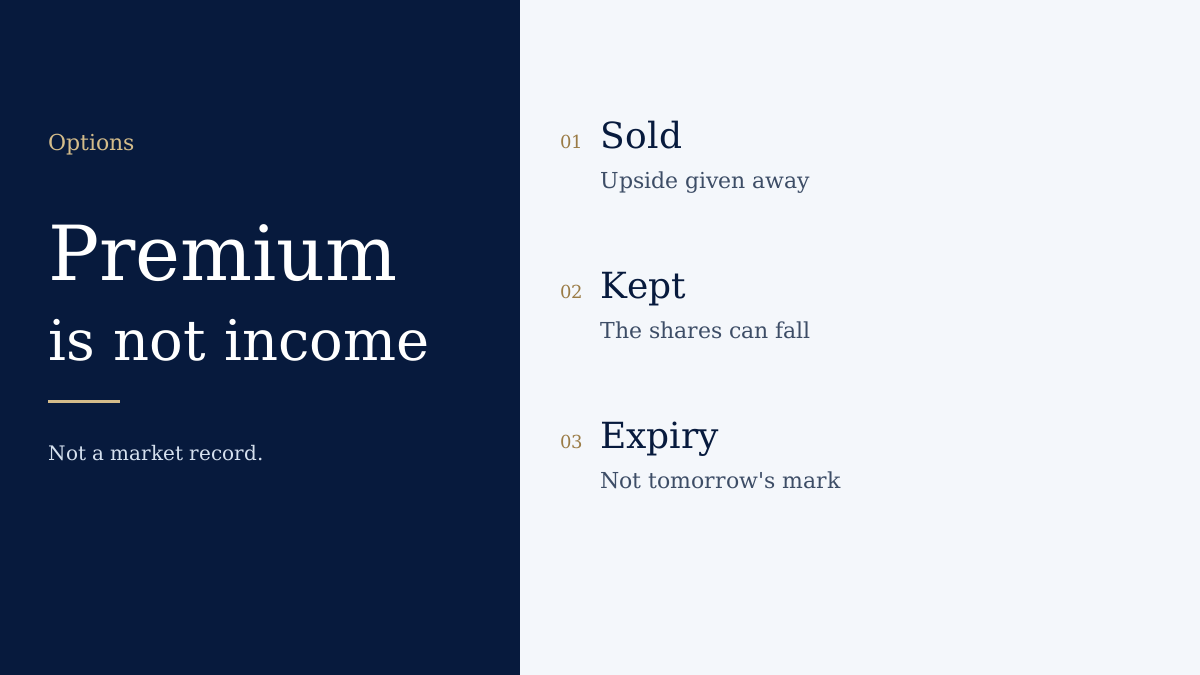
Selling a call against shares you hold takes a premium and gives away gains above the strike. The shares can still fall. The premium is the price of that exchange. It is not a yield that removes the downside.
Key points
- The premium is received because the upside is sold.
- Below the strike, the shares drive the loss. The premium only offsets a slice of it.
- The payoff calculator draws the result at expiry from inputs you type. It is not the value of the contract tomorrow.
What is going on
At expiry, a covered call keeps the shares and the premium if the share price finishes below the strike, and it can be assigned if the price finishes above the strike, so the gain above that strike is not yours. Before expiry the contract’s value also moves with time and with implied volatility. Those are not in the expiry diagram. Early assignment, where the contract allows it, can arrive before the picture you drew. The Options Clearing Corporation describes contract terms. A brochure that calls the premium income has skipped the cap and the remaining downside.
Why it matters
If the shares fall by more than the premium, the position loses money. If the shares rise far through the strike, the position gains less than the shares alone. Comparing only the premium with a dividend confuses a one-off sale of an option with a distribution from the company. Costs include the spread on the contract and any commission. Liquidity in the strike you want may be poor.
What to watch
Write the strike, the expiry, the premium you would actually receive after the spread, and what you will do if assigned. Match the number of shares to the contract size. Do not describe the premium as a return on the shares without subtracting the path of the shares.
Risks
The downside of the shares remains. A halt, a gap, or an early assignment can change the timetable. This note does not quote a live premium.
Expiry is not tomorrow
An expiry diagram is the contract’s settlement shape if it is held to that date. Before then, the price you could close at depends on volatility, time and the share price. The calculator on this site draws the expiry shape you specify. It does not forecast the mark tomorrow.
Related
Sources and review
Written by: WiT Markets Editorial. Writes and structures WiT Markets pages. Separates a sourced fact from a cell that is Not confirmed.
Review: Editorially reviewed. This is not a qualified specialist review and it is not a legal sign-off.
Last reviewed: . Next review due . The date is an editorial pass. It is not a live check of every third-party fee.
Regulatory and official sources
- Investor.gov — checked 13 October 2026
Other sources
- Options Clearing Corporation — checked 13 October 2026
- WiT Markets methodology — checked 13 October 2026
Methodology. Editorial policy. Corrections. Report an error.