Research
Rebalancing changes weights. It does not time the market
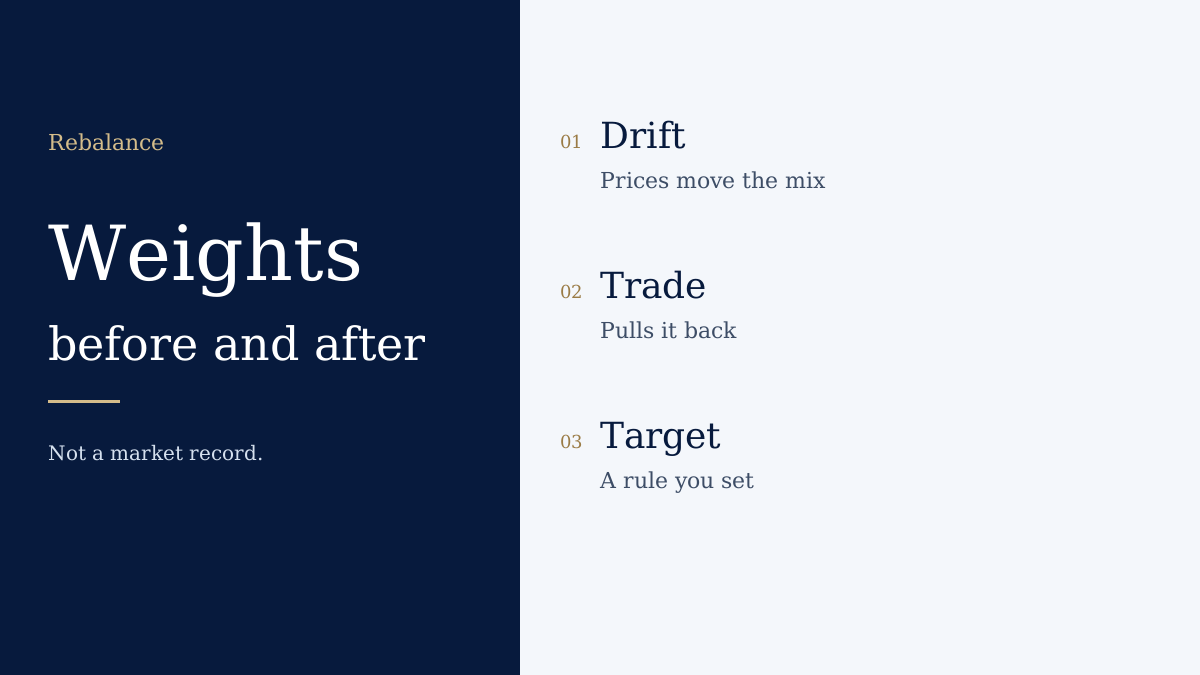
Rebalancing sells what has become a larger share and buys what has become a smaller share, back toward weights you chose earlier. That is a risk rule. It is not a claim that the thing you buy will rise.
Key points
- A rebalance restores weights. A forecast is a separate statement this desk is not making.
- Trend following, momentum and mean reversion assume different things about what recent prices mean.
- A hedge transfers a risk. It also adds cost, basis and the chance the hedge does not match the exposure.
What is going on
Active trading rules need a definition. Trend following and momentum keep exposure in the direction of a recent move. Mean reversion does the opposite, on the assumption that a move fades. Position size and the distance to an exit decide whether any of those rules can be survived. A reward-to-risk ratio describes the plan. It does not describe the probability that the plan works. The risk and reward calculator will compute the ratio from prices you type. It will not tell you the trade’s chance.
Why it matters
Derivatives change the shape of the result. A future can hedge a later purchase or sale, and it can also be a leveraged bet. A covered call sells upside on shares you hold. A protective put pays a premium for a floor that is only as good as the contract and the fill. A vertical spread caps both the gain and the loss relative to a single option. Each of those sentences is a structure. None is a record of profit. The options payoff calculator draws the expiry result of a structure you specify. It is not a price for the option before expiry.
What to watch
For a rebalance, write the weights, the band that triggers a trade, and whether new contributions are allowed to do the work without sales. For a hedge, write the instrument, the size, the expiry and the basis between the hedge and the thing being hedged. Costs include commissions, spreads and, where relevant, the option premium.
Risks
Rebalancing can sell a holding that keeps rising and buy one that keeps falling. A hedge can lose money while the thing it was meant to protect also loses money, if the match is poor. Leverage can force an exit before the story you wrote has time to be wrong in an interesting way. These are limits, not a ranking of strategies.
Related
Sources and review
Written by: WiT Markets Editorial. Writes and structures WiT Markets pages. Separates a sourced fact from a cell that is Not confirmed.
Review: Editorially reviewed. This is not a qualified specialist review and it is not a legal sign-off.
Last reviewed: . Next review due . The date is an editorial pass. It is not a live check of every third-party fee.
Regulatory and official sources
- Investor.gov — checked 13 October 2026
Other sources
- Options Clearing Corporation — checked 13 October 2026
- CME Group — checked 13 October 2026
- WiT Markets methodology — checked 13 October 2026
Methodology. Editorial policy. Corrections. Report an error.