Research
Position size is the loss you have agreed to repeat
Risking a stated fraction means the cash amount shrinks as the account shrinks, if you recalculate. A string of losses still compounds. The fraction is not a forecast of how often you will be wrong.
Key points
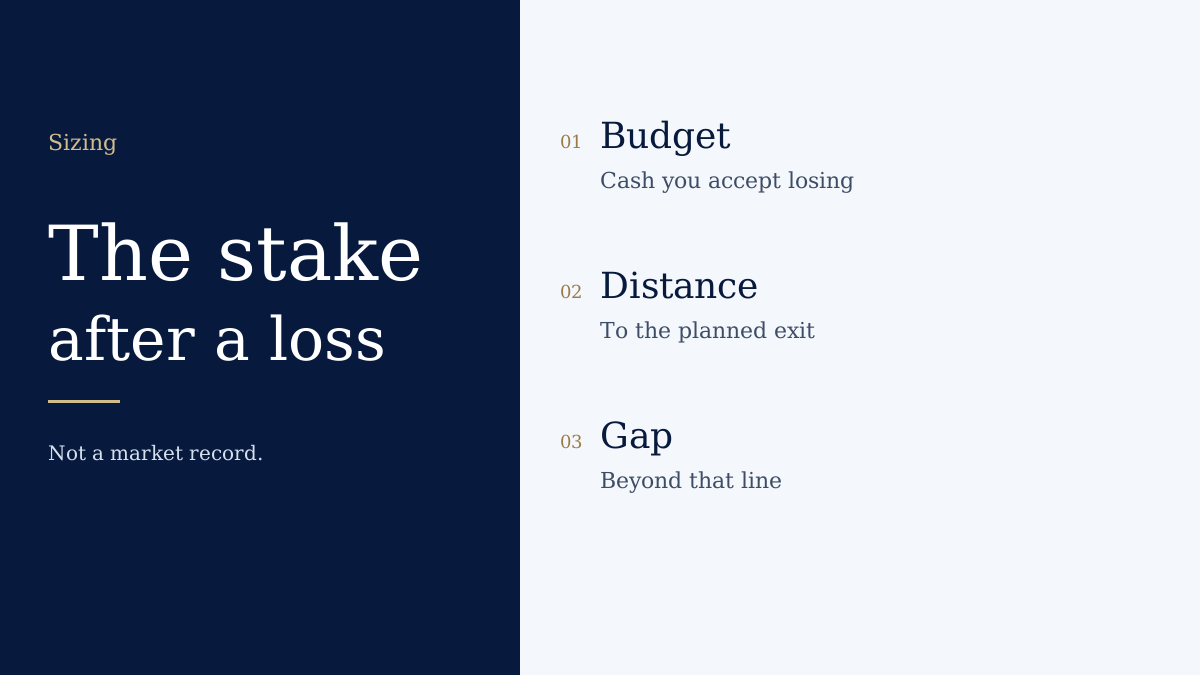
- The position-size calculator turns a loss budget and a distance into a quantity.
- A gap makes the realised loss larger than the budget.
- A sequence of independent coin-flips is a different model from a market.
What is going on
Fixed-fraction sizing risks the same share of the remaining account on the next idea. After a loss, the next stake is smaller if you recompute it. Stop-based sizing divides the cash budget by the distance to the exit. Neither formula knows the win rate. A textbook product of many independent bets can show a high chance of ruin for a large fraction. Markets are not independent bets, and this site will not dress that textbook product up as your probability.
Why it matters
The useful question is whether you can survive a run of losses at the size you actually trade, including slippage. Correlated positions spend the budget together. A reward-to-risk ratio from prices you type is a description of those prices. It is not the chance the target is hit.
What to watch
Write the fraction, the distance, and the number of positions that can lose at once. Recalculate when the account changes. Do not keep the old quantity after a large loss unless that was the rule.
Risks
Sizing limits the planned loss. It does not limit a gap, a halt, or a position you cannot close.
Related
Sources and review
Written by: WiT Markets Editorial. Writes and structures WiT Markets pages. Separates a sourced fact from a cell that is Not confirmed.
Review: Editorially reviewed. This is not a qualified specialist review and it is not a legal sign-off.
Last reviewed: . Next review due . The date is an editorial pass. It is not a live check of every third-party fee.
Regulatory and official sources
- Investor.gov — checked 13 October 2026
Other sources
- WiT Markets methodology — checked 13 October 2026
Methodology. Editorial policy. Corrections. Report an error.