Financial risk and market structure research
Risk & Volatility Research
Understand how losses, leverage, liquidity and market stress affect financial positions.
Explore independent research on drawdowns, volatility, portfolio concentration, market liquidity, trading execution, margin and counterparty risk. Understand the mechanisms behind financial losses and test hypothetical risk scenarios using transparent assumptions.
Explore risk researchOpen risk analysis labUse risk calculatorsMethodology
- Volatility. Scatter of returns around a reference.
- Drawdown. Decline from a previous peak.
- Liquidity. Whether the size can trade near the price you see.
- Permanent loss. Value that is not restored.
Featured research
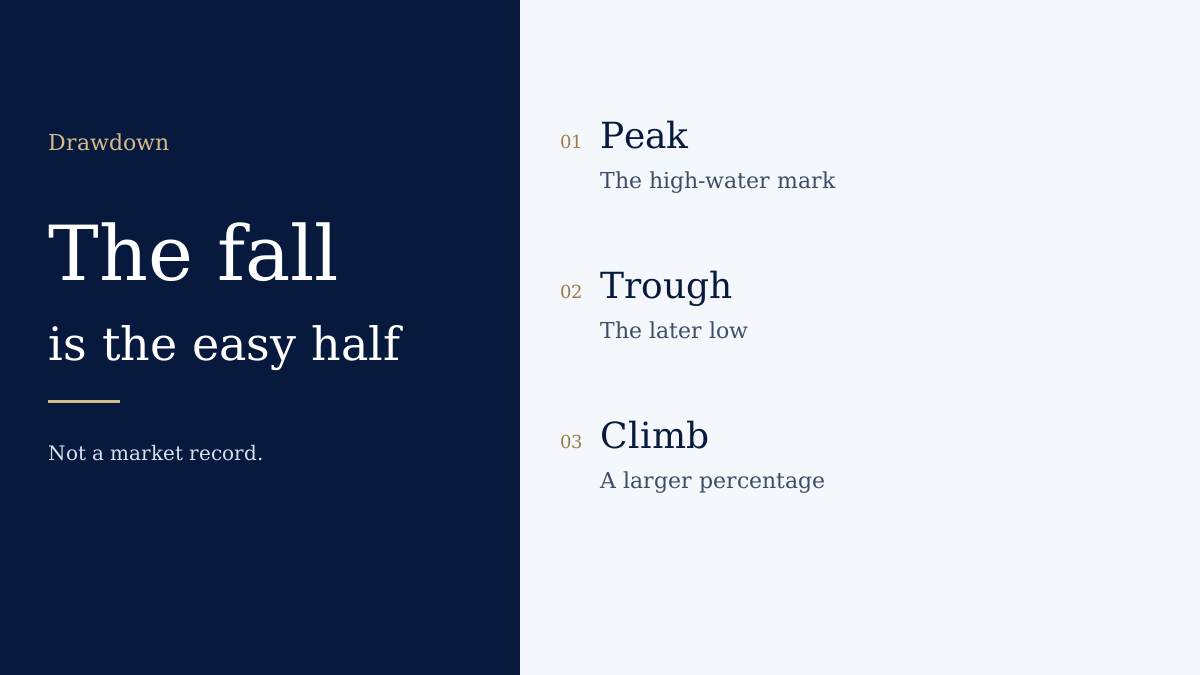
Drawdowns
A drawdown is the climb back, not only the fall
How peak-to-trough loss is measured, why the recovery percentage is larger than the fall, and what a cumulative-result drawdown does not say.
Read research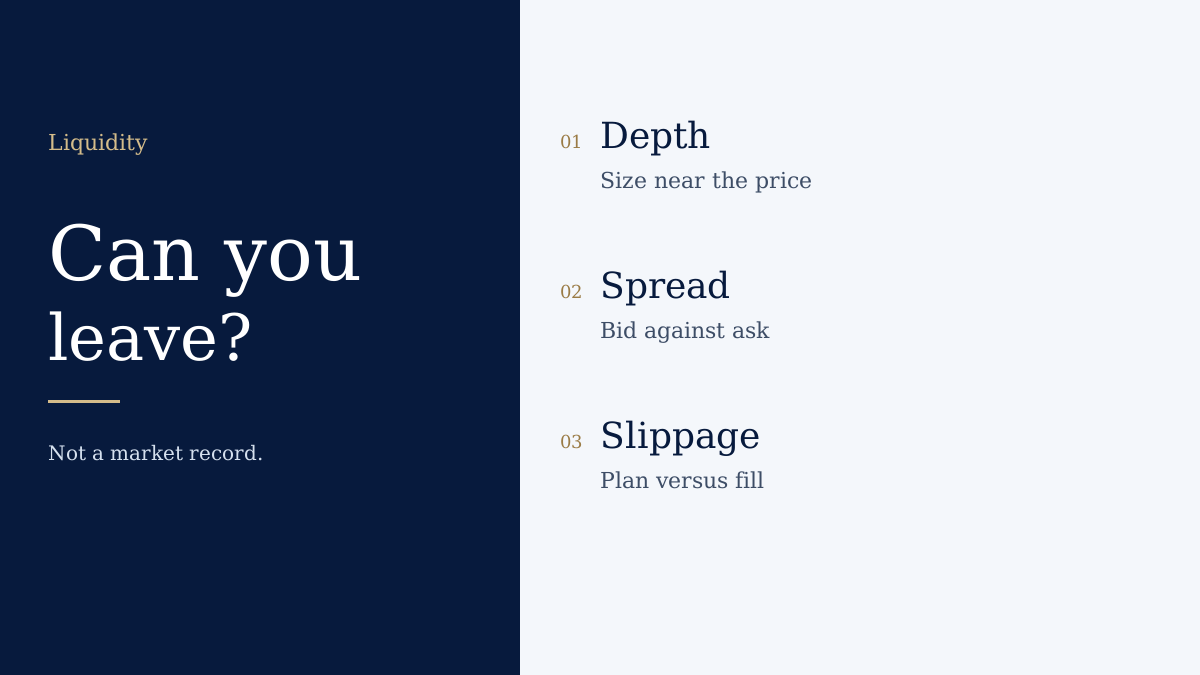
Liquidity is the trade you can exit, not the market you have read about
How depth, spreads, slippage and concentration change the result you can actually realise.
Read research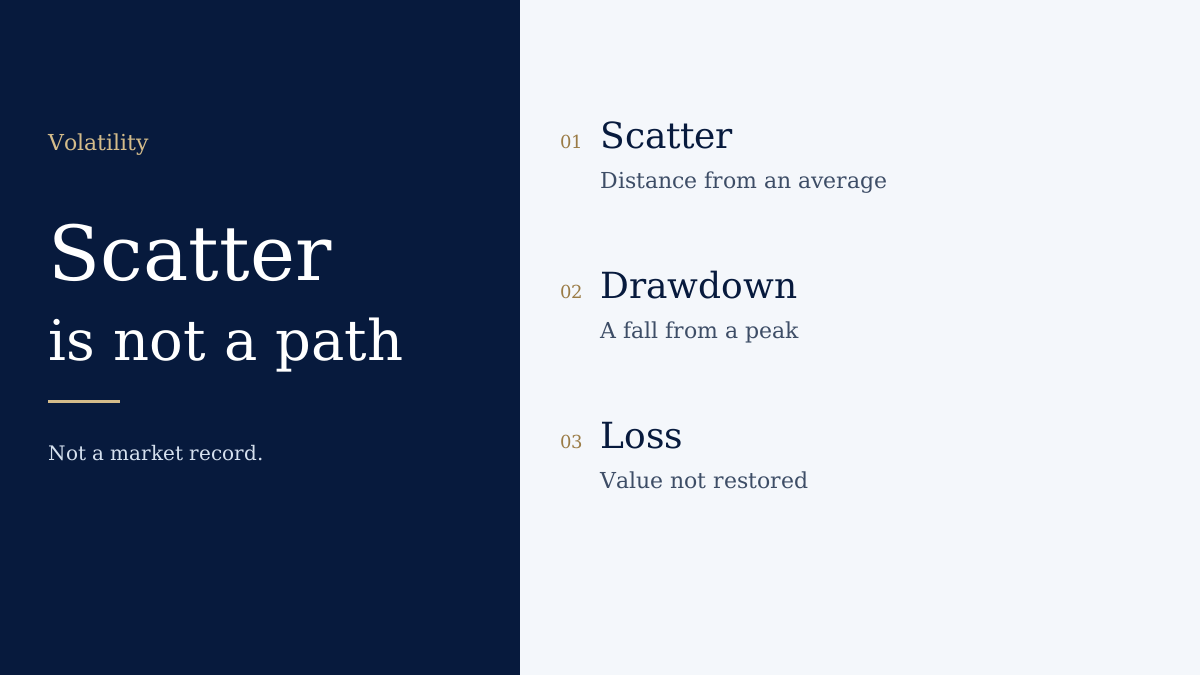
Volatility and a drawdown measure different things
Why the scatter of returns, a fall from a peak, a loss that is not recovered, and a market you cannot leave are four descriptions.
Read research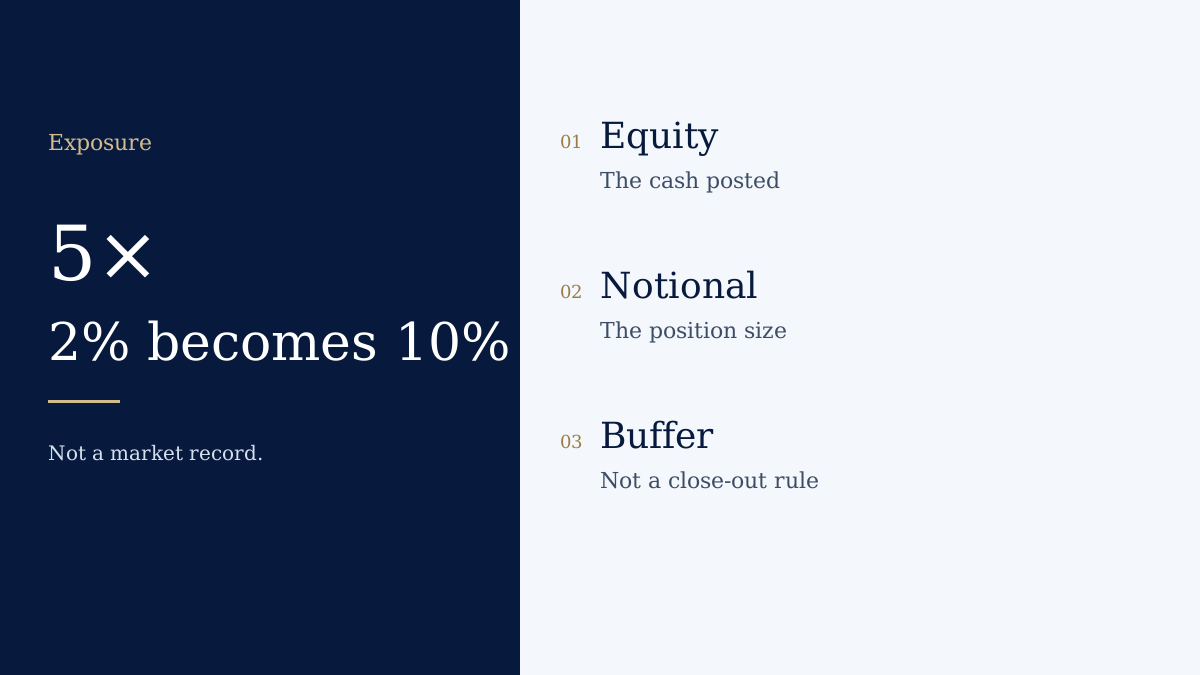
A small price move can be a large result on the cash posted
How notional exposure relative to equity changes the account result of a price move, before product-specific collateral rules.
Read researchRisk categories
Eight mechanisms. The count is published notes in this section that carry the tag. A note can carry more than one. The count is not a ranking.
Volatility and market risk
Scatter around an average, a fat tail, and a regime are descriptions of a sample. They are not the loss from a peak.
Key question. Does a calm historical scatter describe the next gap?
1 published note
Category researchDrawdowns and recovery
A fall is measured from the peak. The gain required to return is measured from what remains.
Key question. What gain restores the same peak?
2 published notes
Category researchLiquidity, spreads and slippage
Depth, the bid-ask gap, and a fill away from the plan are the cost of leaving. A famous market can still be a thin ticket.
Key question. What happens when the book cannot take the order at the price on the screen?
3 published notes
Category researchLeverage, margin and liquidation
Notional relative to equity magnifies a price move. Collateral rules can demand cash before the idea is resolved.
Key question. How far can the price move before the cash supporting the position is no longer enough?
2 published notes
Category research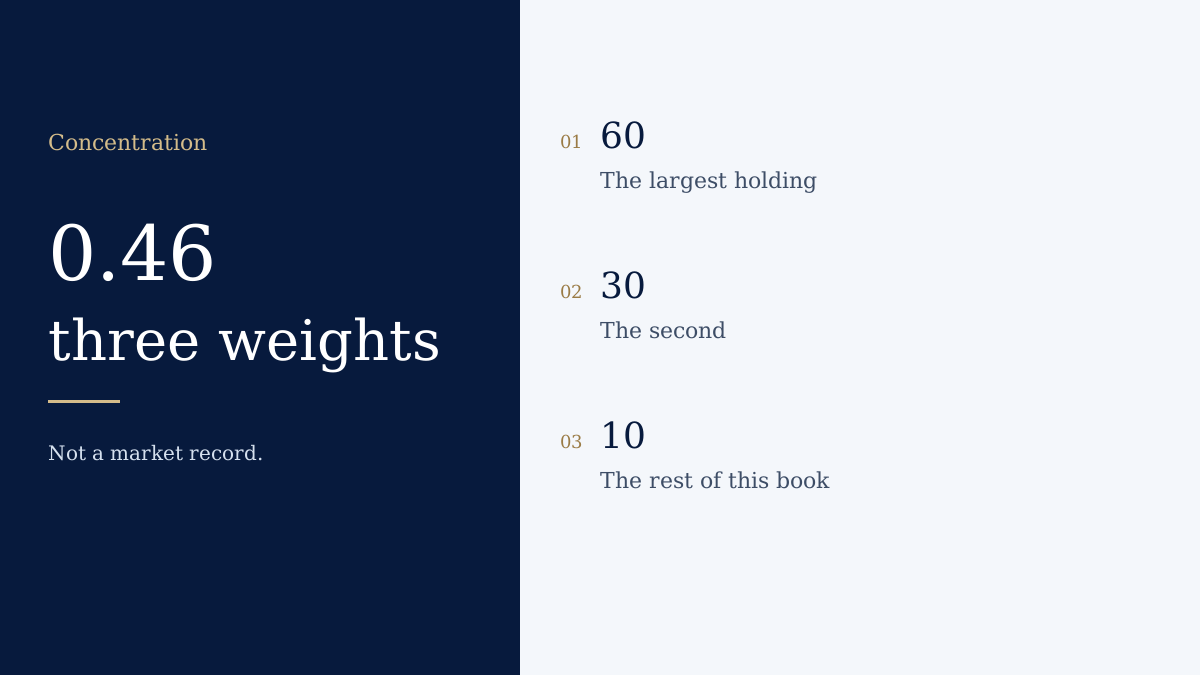
Concentration and correlation
A count of names is not a count of risks. A calm correlation is a window, not a promise that holdings will keep diverging.
Key question. Which holdings would fall together?
2 published notes
Category research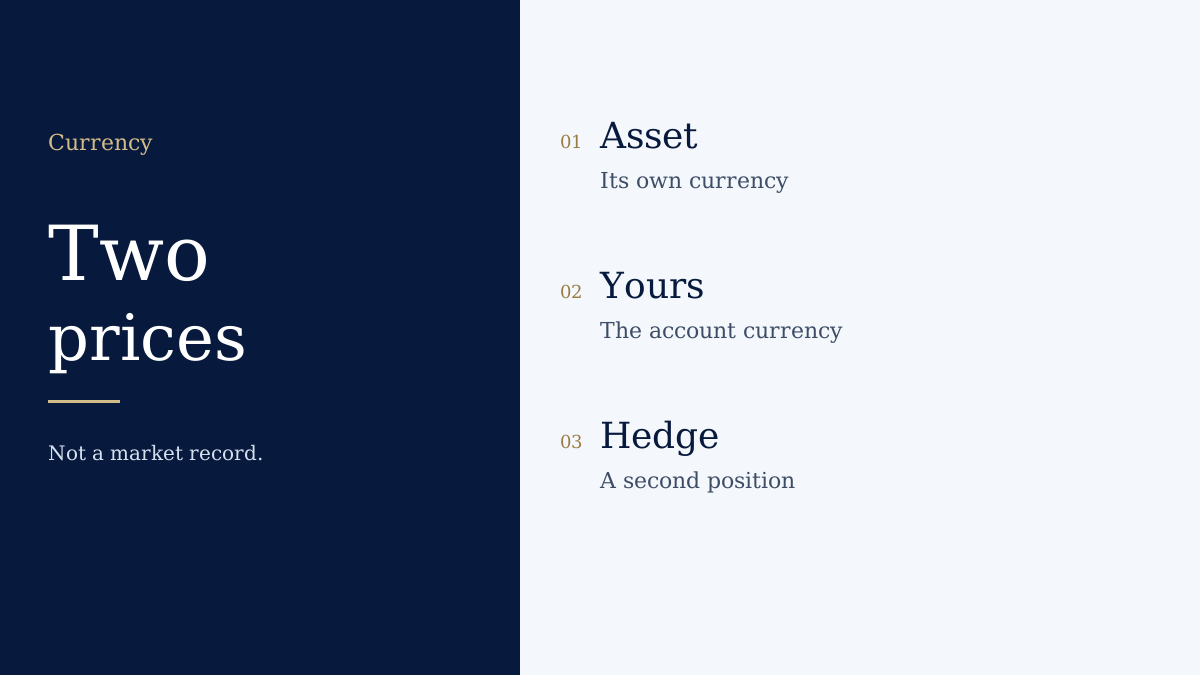
Currency, credit and the firm
A foreign price has a second result in your currency. A bilateral contract adds the firm on the other side.
Key question. Who owes you, and in which currency?
1 published note
Category research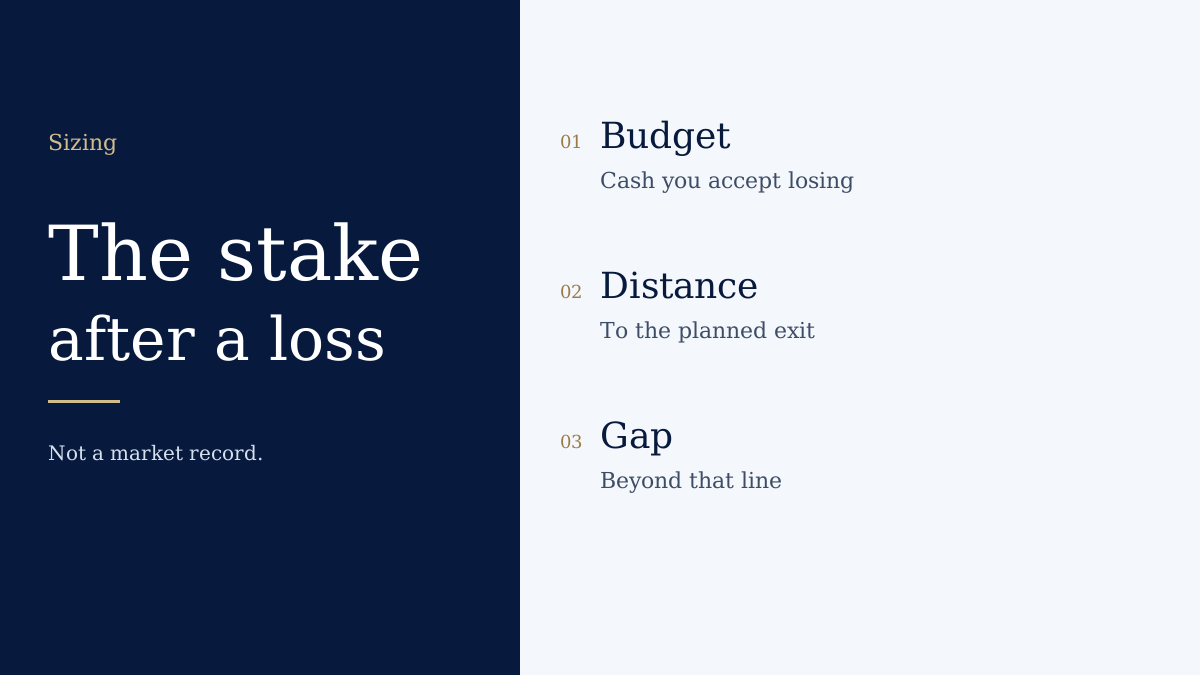
Position size and trading risk
A fraction of capital and a distance to an exit are ways to write a quantity. A gap can make the realised loss larger.
Key question. What is the loss if several positions fail together, and the exit is worse than the line?
2 published notes
Category research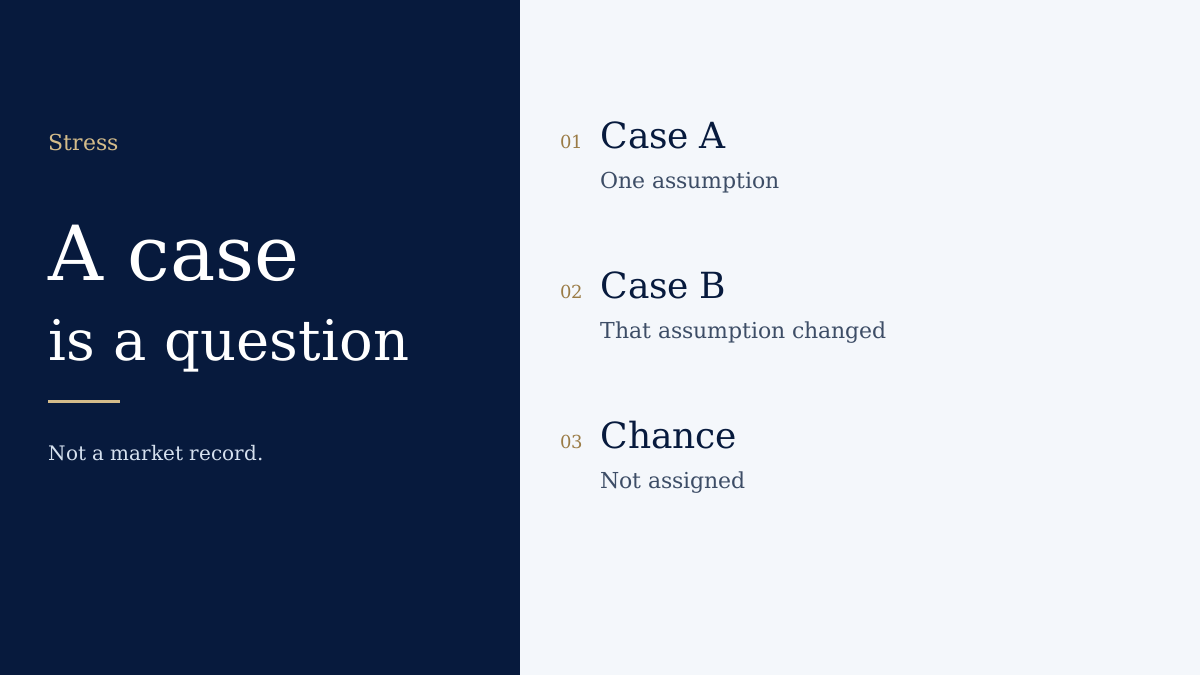
Tail risk and stress tests
A scenario changes an assumption you can name. It does not become a probability because the table looks precise.
Key question. Which assumption, if it failed, would change the result you are looking at?
3 published notes
Category researchRisk and market stress lab
Each module uses numbers you type. The drawdown module uses the same recovery function as the drawdown calculator. Nothing here is a live price, a broker close-out rule, or a probability.
- Capital loss
- USD 20,000.00
- Drawdown
- 20.00%
- Remaining capital
- 80.00%
- Required recovery
- 25.00%
- Recovery multiple
- 1.25×
| Drawdown | Required recovery |
|---|---|
| 10% | 11.11% |
| 20% | 25.00% |
| 30% | 42.86% |
| 40% | 66.67% |
| 50% | 100.00% |
| 60% | 150.00% |
| 75% | 300.00% |
| 100% | No finite recovery |
Volatility is not the same as a drawdown
Volatility is dispersion around a reference mean. A drawdown is a decline from a high-water mark. A permanent loss is value that is not restored. Liquidity risk is difficulty transacting at an acceptable price or size. Two synthetic paths can be imagined that finish near the same place and spend different times below a peak. This page does not draw those paths as if they were an index.
The recovery table in the lab is the arithmetic: a 20 percent fall needs a 25 percent gain, and a 50 percent fall needs a 100 percent gain. Those rows are identities. They are not a history.
Two types of liquidity
Market liquidity is the ability to trade a size near a price. Funding liquidity is the ability to keep the cash and collateral the position requires. A wider spread, a thinner book, a higher collateral demand and a forced reduction can arrive together. High average volume does not promise that the book will be there in a stress. An illiquid holding is not automatically the most volatile. The two failures are different.
Understanding tail risk
Fat tails, gaps, clustered volatile periods, and correlations that rise in a stress are reasons a bell curve fitted to ordinary days understates extreme losses. A short option can collect a small premium and owe much more. This section does not publish a value-at-risk figure. A VaR number would need a confidence level, a horizon, a method and a dataset. It would still not be a maximum loss. Expected shortfall is a different summary of the tail. Neither is estimated here.
Risk management for active traders
Write the quantity from a loss you accept and a distance you can defend. A reward-to-risk ratio is a description of those prices, not the chance the target is hit. A stop-market seeks the next available price. A gap or a halt can pass the line. Several correlated positions spend the budget together. Leverage changes how fast the account feels the move. A drawdown limit is a rule you set. It is not a property of the market.
Position size · Risk and reward · Stop and target · Journal · Performance
Why a derivative changes the risk
Futures
Notional can be large relative to the cash posted. Initial and maintenance collateral, daily settlement, price limits, expiry and delivery are part of the contract. This page does not reprint a live schedule.
Collateral can close the positionOptions
A long contract can expire worthless, with the premium spent. A short contract without cover can owe more than the premium. Time and implied volatility move the mark before expiry.
A sold contract can owe moreContracts for difference and forex
A bilateral contract adds the firm. Financing, a close-out rule and a gap sit beside the price. A currency pair has a pip value and a conversion into the account currency. Read the entity on the contract.
The legal entityVolatility products
A futures curve, a roll, and an option on volatility are path-dependent. A level you remember is not today’s term structure. This desk does not print a fear gauge.
Scatter is not a pathThe firm behind the trade
The contracting entity, its regulator, the execution arrangement, custody, clearing and client-asset rules are part of the risk. Authorisation does not mean the position cannot lose money, and it does not make every product eligible for every person. Operational failure is separate from the market move.
The legal entity on the contract · Broker and platform intelligence
What the lab will not do
It will not show an infinite recovery from a zero balance. It will not fill an order beyond the book you typed. It will not infer a correlation from weights. It will not call a typed collateral buffer a broker’s liquidation price. It will not assign a probability to a scenario.
Latest research
Search matches the title and the summary. Filters use the tags on published notes. Unpublished ideas are not listed.
Risk & VolatilityDrawdown
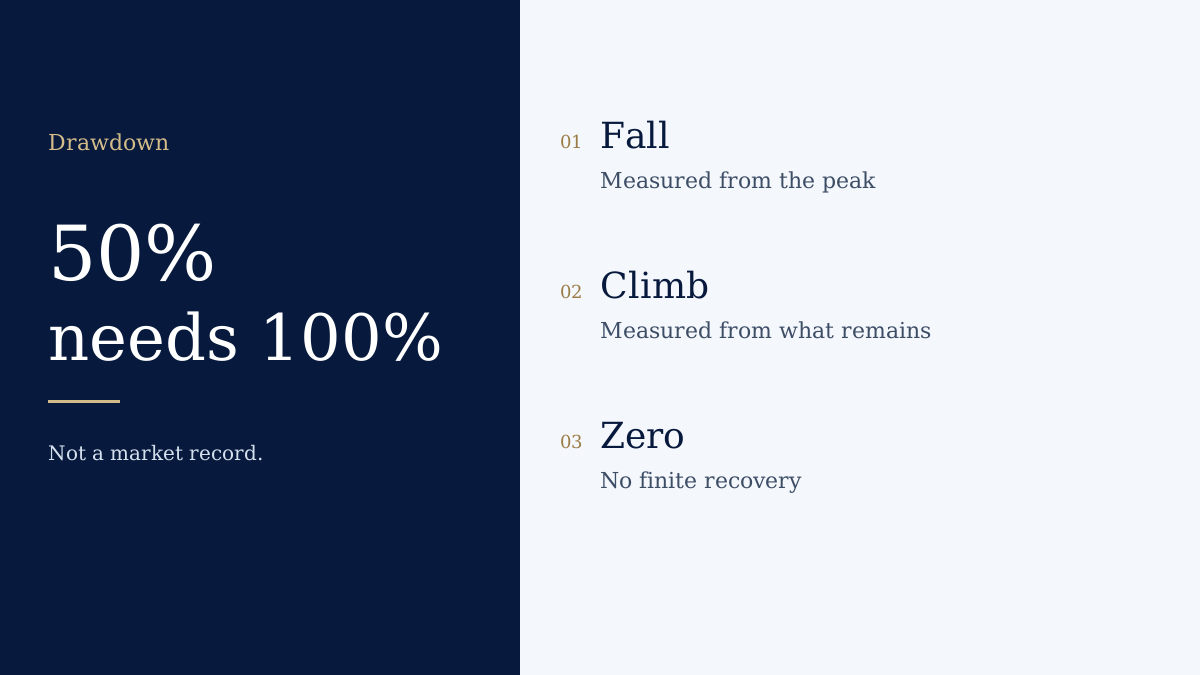
A 50 percent fall needs a 100 percent gain to recover
The recovery identity: peak divided by the trough, minus one. Worked from a peak of 100 to a trough of 80, 50 and zero.
- From 100 to 80, the fall is 20 percent and the climb back is 25 percent.
- From 100 to 50, the fall is 50 percent and the climb back is 100 percent.
- The drawdown calculator uses a peak and a current value you type.
Risk & VolatilityStress
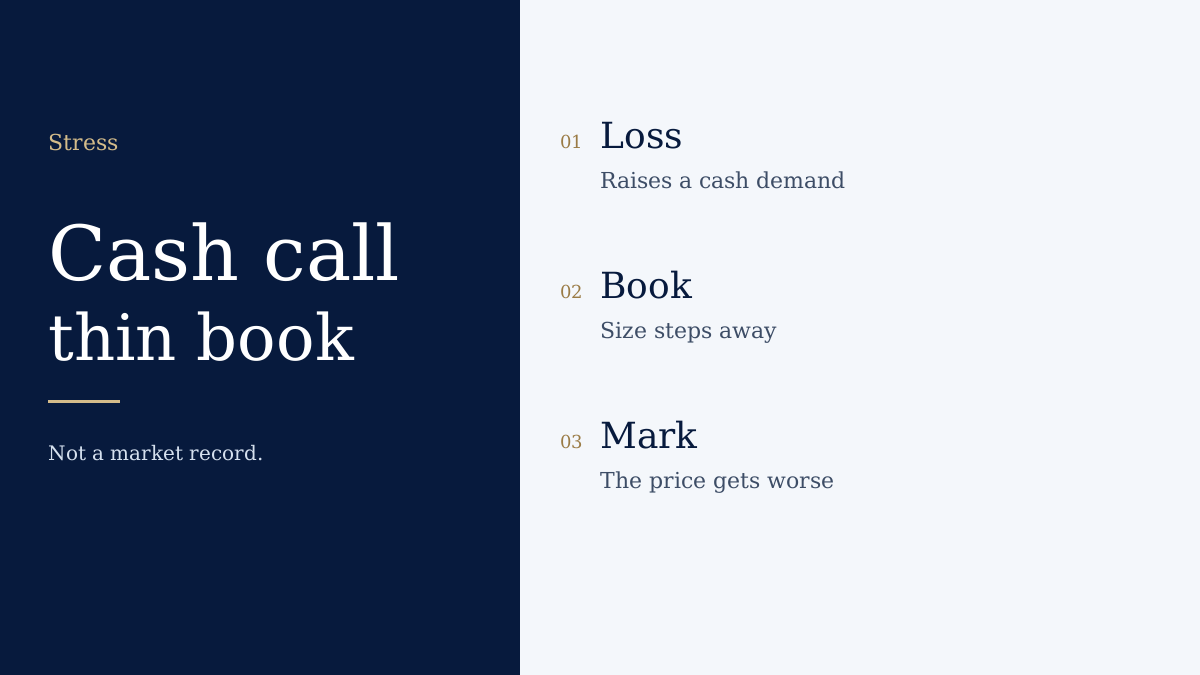
A cash demand and a thin book can worsen each other
How a collateral call, a wider spread, and forced selling can arrive together. No crisis is given a made-up percentage.
- A wider spread and a collateral call are different events that can coincide.
- Forced selling can push the price that the collateral rule is marking.
- This note does not assign a probability to that loop.
Risk & VolatilityCurrency and the firm
A foreign holding carries the currency as well as the asset
How translation into the holder’s currency, a hedge of that currency, and a conversion charge are separate from the asset’s own price.
- The asset result and the currency result add. They are not the same move.
- A hedge of the currency can itself need collateral and can miss.
- This note does not quote a live exchange rate.
Risk & VolatilityStress
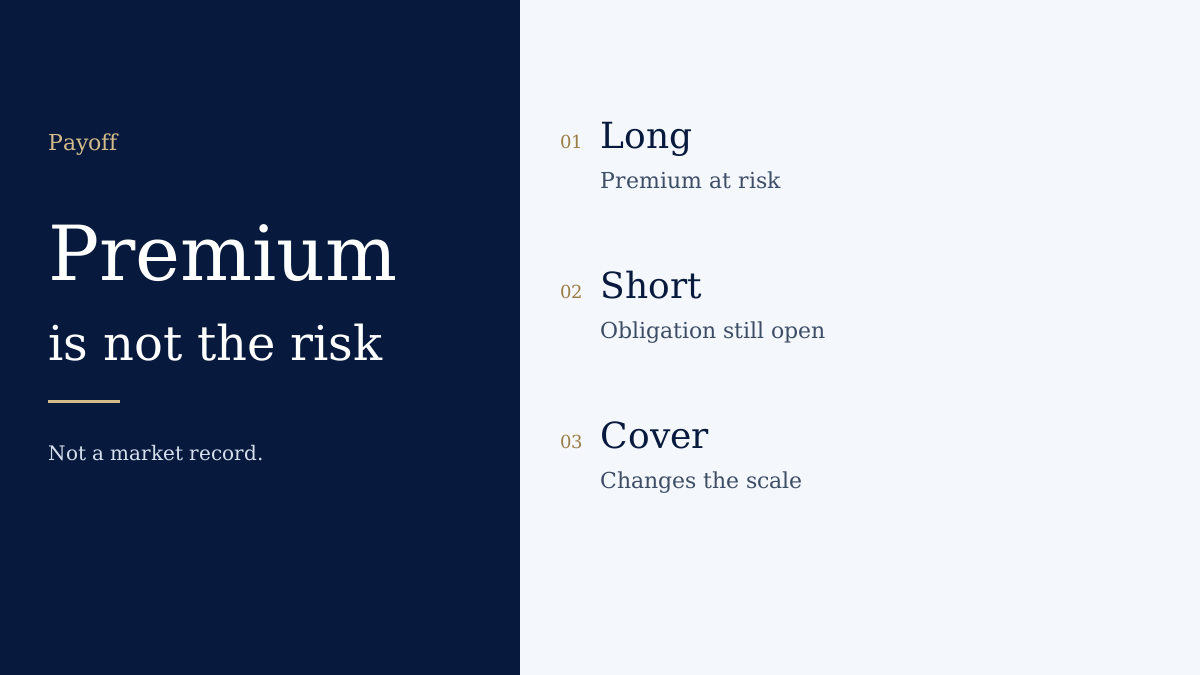
A small premium can sit in front of a large obligation
How a long option risks the premium, and how a short option without a covering holding can owe much more. Expiry drawings are not tomorrow’s mark.
- A long option can expire worthless. The premium is the spent amount.
- A short option can lose more than the premium if it is not covered by a holding or a spread.
- The payoff calculator draws expiry from inputs you type.
Risk & VolatilityExposure
A small price move can be a large result on the cash posted
How notional exposure relative to equity changes the account result of a price move, before product-specific collateral rules.
- Notional divided by equity is the exposure multiple in the illustration.
- A 2 percent adverse move on a notional five times the equity is about a 10 percent result on that equity, before costs.
- A generic buffer is not the price at which a firm will close the account.
Risk & VolatilityPosition size
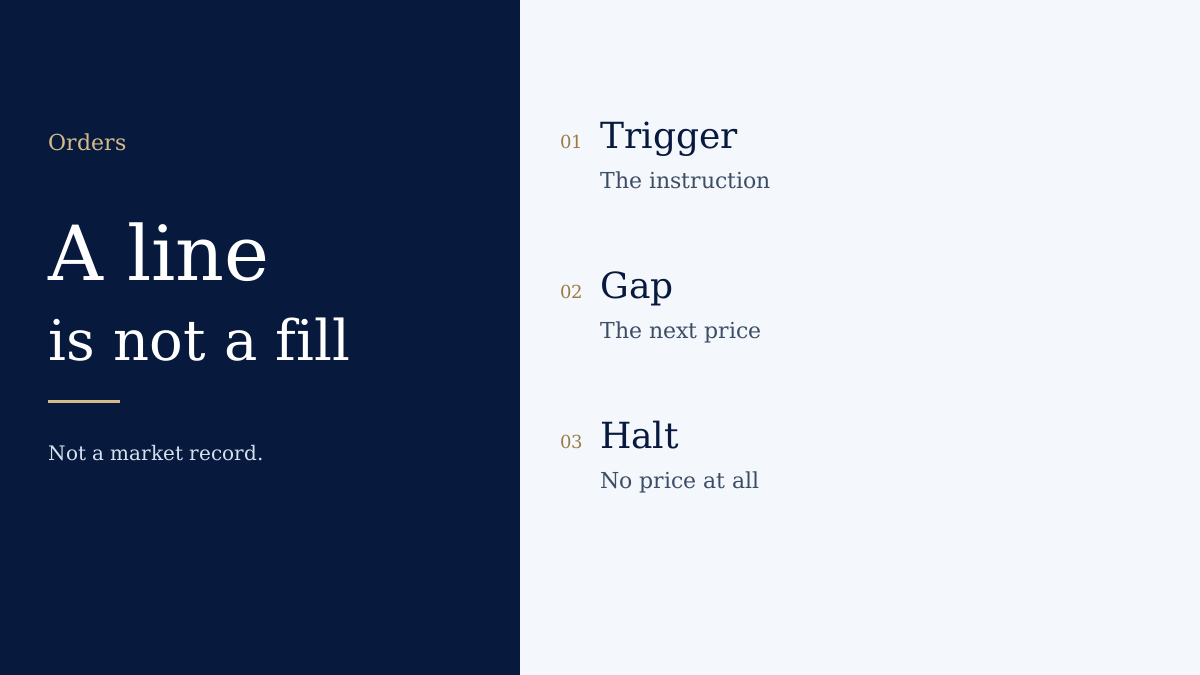
A stop is an instruction, not a guaranteed price
How a stop-market seeks a fill at the next available price, and how a gap or a halt can pass the level you typed.
- Size the loss from a worse exit than the stop, if the stop is a market order.
- A stop-limit can refuse the bad price and leave the position on.
- The stop calculator uses prices you type. It does not promise a fill.
Put risk research into practice
Market and trading risk
Portfolio risk
Derivatives and leverage
Prop trading
Where the same question continues
- Listed contracts, where collateral and expiry are part of the risk
- Listed options, where a short contract can owe more than the premium
- Currency markets
- Commodity markets, including gold and energy
- Shares
- Index markets
- Asset class research
- Investment and trading strategies
- Broker and platform intelligence
- The legal entity on the contract
How this section is written
A source is cited when a claim needs one. A calculator result stays inside the tool, with the assumption visible. Hypothetical numbers in the lab are labelled as illustrations. Commercial relationships do not order these notes. Regulation is not described as protection against a market loss. The methodology and the risk disclosure are the longer versions of those limits.
MethodologyEditorial policyRisk disclosureCommercial disclosureCorrections
Sources and review
Written by: WiT Markets Editorial. Writes and structures WiT Markets pages. Separates a sourced fact from a cell that is Not confirmed.
Review: Editorially reviewed. This is not a qualified specialist review and it is not a legal sign-off.
Last reviewed: . Next review due . The date is an editorial pass. It is not a live check of every third-party fee.
Regulatory and official sources
- Investor.gov — checked 13 October 2026
Other sources
- Bank for International Settlements — checked 13 October 2026
- WiT Markets methodology — checked 13 October 2026
Methodology. Editorial policy. Corrections. Report an error.