Research
A small price move can be a large result on the cash posted
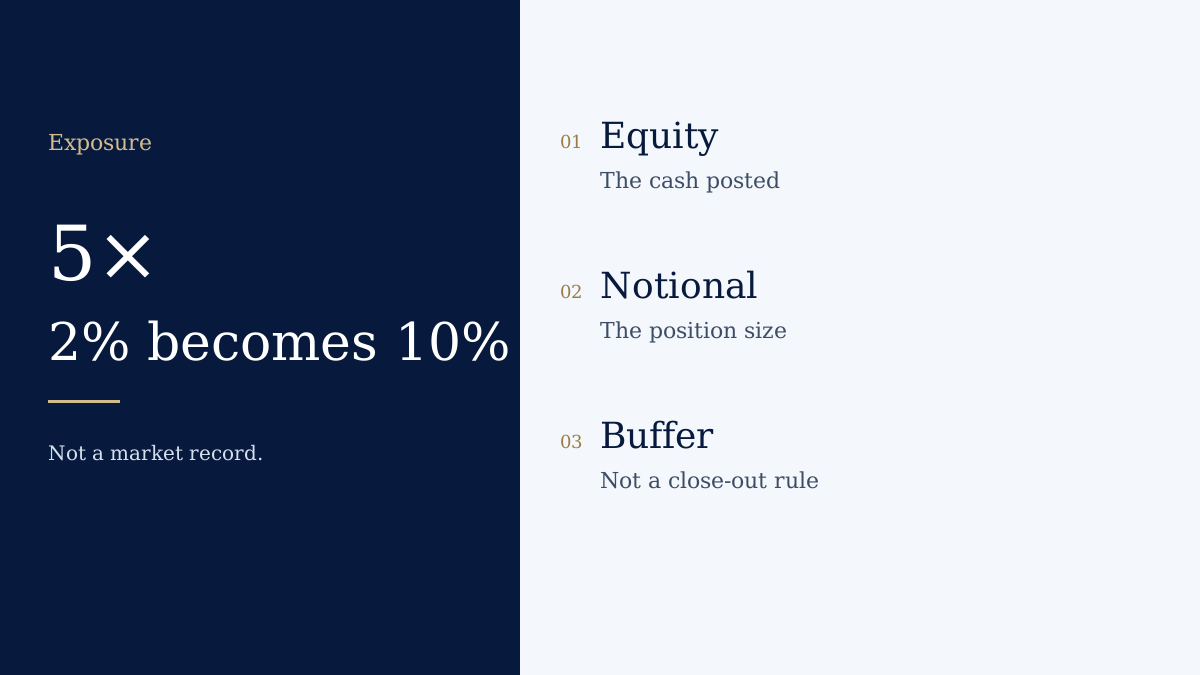
If the position is larger than the cash supporting it, the same price change is a larger percentage of that cash. The illustration is not a broker’s liquidation rule.
Key points
- Notional divided by equity is the exposure multiple in the illustration.
- A 2 percent adverse move on a notional five times the equity is about a 10 percent result on that equity, before costs.
- A generic buffer is not the price at which a firm will close the account.
What is going on
Account equity of 10,000 and a notional of 50,000 is a fivefold exposure. An adverse 2 percent move on that notional is 1,000, which is 10 percent of the starting equity before costs. A favourable move scales the same way. A short position flips the sign of the price move. Added costs reduce the ending equity. Collateral required at the start and the level at which a shortfall appears are percentages you type. They are not read from a broker schedule.
Why it matters
The cash demand can arrive before the reason you held the position has been resolved. Daily settlement on a listed contract, a higher house requirement, and a gap are different mechanisms that can all demand cash. The futures calculator on this site uses a contract size you enter. This note does not reprint a venue’s current requirement.
What to watch
Write the equity, the notional, the direction, the move you are testing, and the costs. Read the firm’s own close-out rule before treating a modelled buffer as a distance you can rely on.
Risks
Losses can exceed the cash posted when the move is larger than the illustration, when several positions move together, or when the exit price is worse than the mark. This page does not say a product is suitable.
Related
Sources and review
Written by: WiT Markets Editorial. Writes and structures WiT Markets pages. Separates a sourced fact from a cell that is Not confirmed.
Review: Editorially reviewed. This is not a qualified specialist review and it is not a legal sign-off.
Last reviewed: . Next review due . The date is an editorial pass. It is not a live check of every third-party fee.
Regulatory and official sources
- U.S. Commodity Futures Trading Commission — checked 14 October 2026
- Investor.gov — checked 13 October 2026
Other sources
- WiT Markets methodology — checked 13 October 2026
Methodology. Editorial policy. Corrections. Report an error.