Research
Liquidity is the trade you can exit, not the market you have read about
A market can be famous and still be a poor place to exit the contract you hold. Liquidity is about the size you can trade, near the price you see, when you need to.
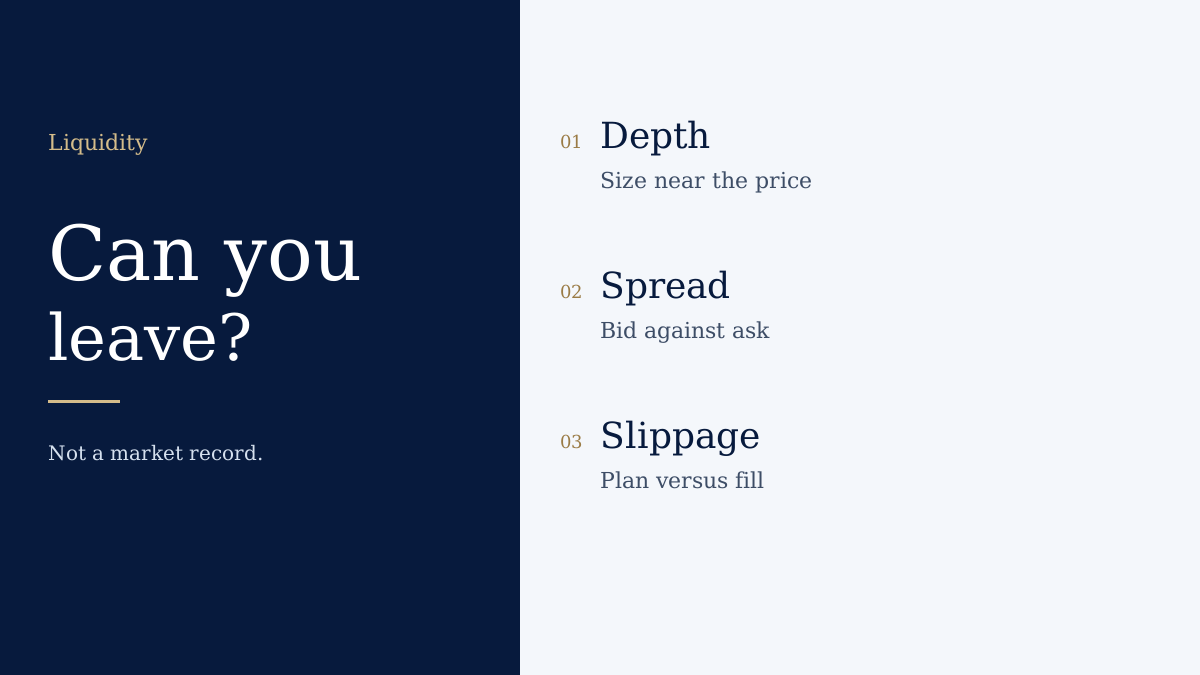
Key points
- A tight spread in a quiet minute does not describe the spread in a fast minute.
- Slippage is the gap between the price you used in the plan and the price of the fill.
- Turnover statistics for an institutional market are not a description of a retail ticket.
What is going on
Market depth is the size available on the bid and the offer near the current price. The spread is the gap between them. Slippage is what you give up when the fill differs from the decision price, including when a stop is triggered and the next trade is worse. Volatility widens that gap because orders arrive faster than the displayed size is replaced. A large published turnover figure can sit in a different instrument, a different hour or a different clientele from the ticket in front of you.
Why it matters
Position size should be set against the loss if the exit is worse than the worksheet, not only against the loss if the exit is exact. The position-size calculator on this site can include a slippage assumption you type. It still cannot know the book. Correlation matters in the same breath: holdings that fell separately in quiet data can fall together when liquidity is the thing that is scarce.
What to watch
Ask how wide the spread became at the last comparable release, not what it was at lunchtime. For a fund, ask how the manager handles a holding that cannot be sold at the last price. For a contract with a broker, ask whether you are in a queue for the firm’s price or in a market with other bids. Concentration in one name, one sector or one broker is a liquidity decision as well as a view.
Risks
This note does not measure today’s spread in any market. A worksheet that assumes a one-tick exit will overstate control. Tail losses are the losses that sit outside the sample you found comforting.
Depth, spread and the size of the order
The spread is the ask minus the bid. A marketable buy lifts the ask. Relative to a symmetric midpoint that is half the spread per unit. Extra slippage is a worse price than that quote. Fees are a separate line. If you already have the fill, the gap from the midpoint includes the spread. Adding the spread again counts it twice. A one-lot trade and a trade larger than the size on the quote are different objects. The average price walks the levels that are actually there.
When the size steps away
Displayed size can be cancelled as you trade. A wide average-volume statistic does not describe the book in a fast minute. If the order is larger than the levels you can see, the remainder has no price until a new level appears. The explorer on this hub will say the modelled book is insufficient rather than invent a deeper one. High average turnover does not promise that the book will be there when cash is demanded.
Related
Sources and review
Written by: WiT Markets Editorial. Writes and structures WiT Markets pages. Separates a sourced fact from a cell that is Not confirmed.
Review: Editorially reviewed. This is not a qualified specialist review and it is not a legal sign-off.
Last reviewed: . Next review due . The date is an editorial pass. It is not a live check of every third-party fee.
Regulatory and official sources
- Investor.gov — checked 13 October 2026
Other sources
- Bank for International Settlements — checked 13 October 2026
Methodology. Editorial policy. Corrections. Report an error.