Research
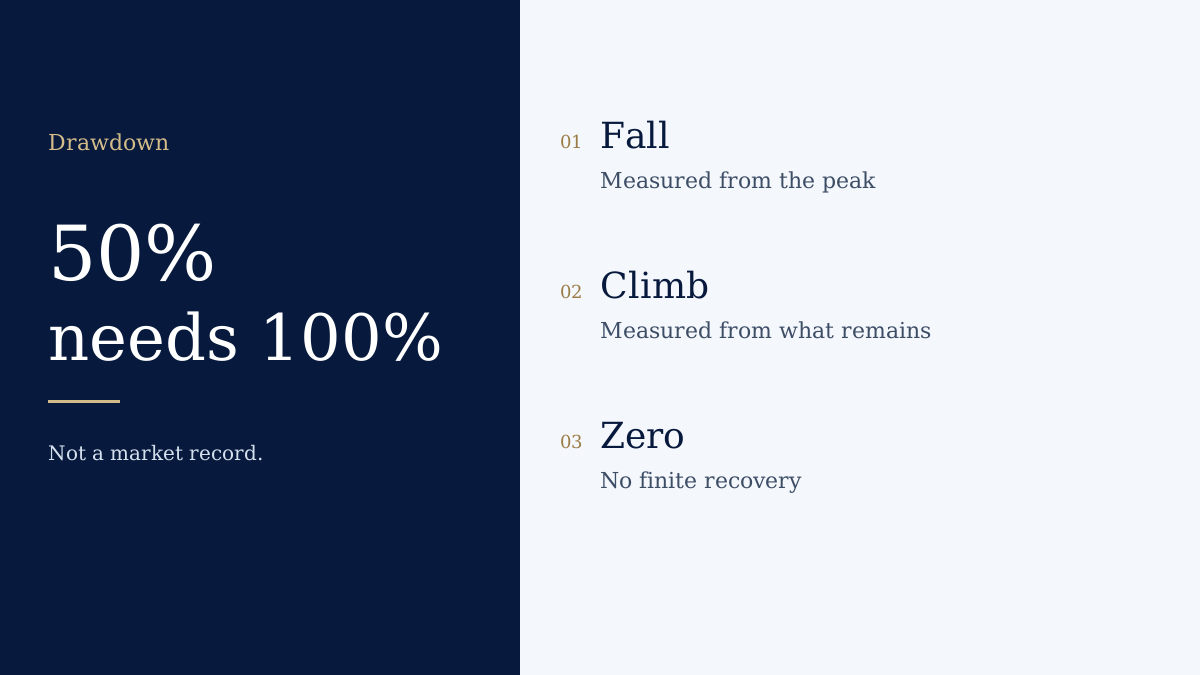
A 50 percent fall needs a 100 percent gain to recover
The percentage lost is measured from the peak. The percentage needed to return is measured from the trough. They are not the same number. A zero balance has no finite recovery percentage.
Key points
- From 100 to 80, the fall is 20 percent and the climb back is 25 percent.
- From 100 to 50, the fall is 50 percent and the climb back is 100 percent.
- The drawdown calculator uses a peak and a current value you type.
What is going on
Loss divided by peak is the drawdown. Peak divided by the remaining value, minus one, is the gain required. At a remaining value of 80 the required gain is 25 percent. At 50 it is 100 percent. At 25 it is 300 percent. At zero the division is not defined. The same identity is in the recovery table on the risk hub. Change the peak and the current value and the calculator recomputes it. It does not look up a market.
Why it matters
A plan that says ‘I can tolerate a 50 percent fall’ has also accepted that a doubling is required to get back to the same peak, before costs and before any withdrawal. Time underwater is a separate fact from the depth. Sequence matters when money is being added or removed. A contribution during the fall buys more units. A withdrawal during the fall locks in the smaller base.
What to watch
Say whether the series is a price, a total return, or an account after deposits. The trading journal’s cumulative result is not this percentage unless you have supplied the capital.
Risks
The identity is arithmetic. It is not a forecast that the recovery will arrive. A further fall makes the required gain larger.
Related
Sources and review
Written by: WiT Markets Editorial. Writes and structures WiT Markets pages. Separates a sourced fact from a cell that is Not confirmed.
Review: Editorially reviewed. This is not a qualified specialist review and it is not a legal sign-off.
Last reviewed: . Next review due . The date is an editorial pass. It is not a live check of every third-party fee.
Regulatory and official sources
- Investor.gov — checked 13 October 2026
Other sources
- WiT Markets methodology — checked 13 October 2026
Methodology. Editorial policy. Corrections. Report an error.