Research
A stress scenario is a question you typed, not a prediction
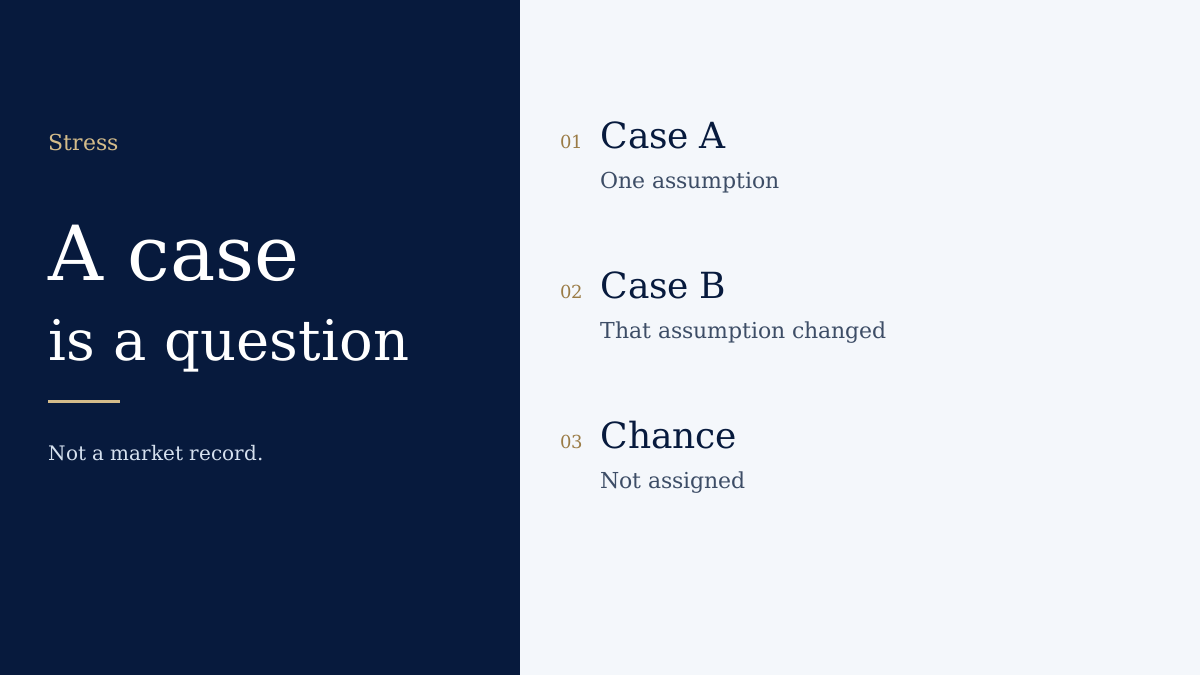
A scenario changes an assumption and shows the arithmetic. It does not say the path will happen. False precision is a precise percentage on a story that had no dataset.
Key points
- Name the assumption that changed between the two cases.
- Do not put a probability on the case unless a model and a sample are stated.
- The lab on this page labels every result as an illustration.
What is going on
Useful comparisons are small. Unlevered versus a larger notional. A half-spread versus a wider one. One holding shocked versus several shocked by the same amount. A 20 percent drawdown versus a 50 percent drawdown, using the recovery identity. Each pair can be recomputed from the inputs. BIS and official education sources discuss stress as a discipline. They do not authorise a website to invent the next crisis path.
Why it matters
A dashboard that ranks scenarios by an unsupported probability looks more finished than a table of assumptions. It is less honest. If the weights do not add up, or the book you typed is smaller than the order, the right output is that fact, not a smoothed price.
What to watch
Keep the two cases identical except for the assumption you meant to change. Write the limitation under the number. Prefer a blank to a borrowed statistic.
Risks
Even a careful scenario misses the risk you did not think to type. That is a reason to keep the list short and the labels plain.
Related
Sources and review
Written by: WiT Markets Editorial. Writes and structures WiT Markets pages. Separates a sourced fact from a cell that is Not confirmed.
Review: Editorially reviewed. This is not a qualified specialist review and it is not a legal sign-off.
Last reviewed: . Next review due . The date is an editorial pass. It is not a live check of every third-party fee.
Other sources
- WiT Markets methodology — checked 13 October 2026
- Bank for International Settlements — checked 13 October 2026
Methodology. Editorial policy. Corrections. Report an error.