Research
The midpoint is not the price of a marketable order
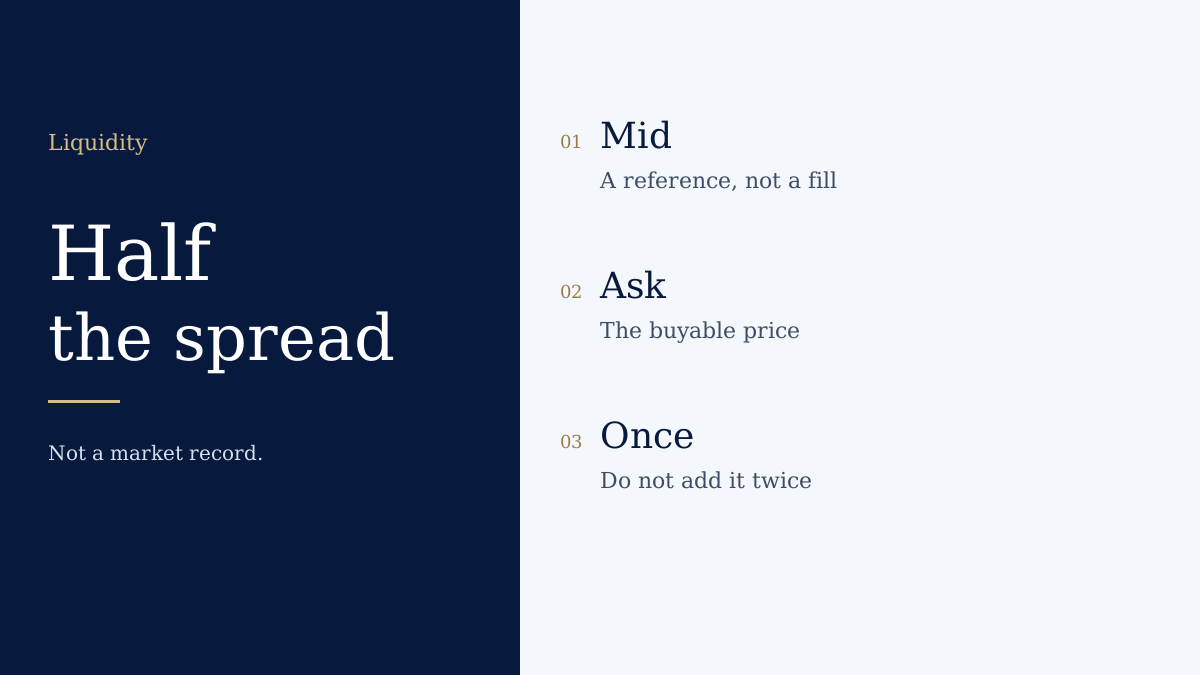
Crossing from the midpoint to the ask is half the spread. Slippage is a further gap. If you already have the fill price, that gap includes the spread. Adding both counts the same cost twice.
Key points
- A midpoint of 100 and a full spread of 0.10 put a buy at 100.05, before extra slippage.
- One thousand units at a half-spread of 0.05 cost 50 relative to the midpoint.
- Actual-price mode measures the gap you type and does not add the spread field again.
What is going on
The spread is the ask minus the bid. A marketable buy lifts the ask. Relative to the midpoint that is half the spread per unit, if the quote is symmetric. Extra slippage is a worse price than that quote. Fees are a third line. FINRA’s order-type material distinguishes the instruction from the fill. It does not publish today’s spread in any name, and neither does this note as a live figure. The numbers above are an arithmetic example.
Why it matters
A plan that marks entries at the midpoint and ignores the spread has described a different trade. A plan that subtracts the spread and also subtracts the difference between a real fill and the midpoint has subtracted the spread twice. The explorer on this hub switches mode when you enter an actual price.
What to watch
Say whether the figure is the full spread or the half-spread, and whether it is per unit. A quiet quote is a poor guide to the quote when you need to leave.
Risks
The example is not a market. Depth can run out before your size is done. That case is the next note.
Related
Sources and review
Written by: WiT Markets Editorial. Writes and structures WiT Markets pages. Separates a sourced fact from a cell that is Not confirmed.
Review: Editorially reviewed. This is not a qualified specialist review and it is not a legal sign-off.
Last reviewed: . Next review due . The date is an editorial pass. It is not a live check of every third-party fee.
Regulatory and official sources
- FINRA — checked 13 October 2026
- Investor.gov — checked 13 October 2026
Other sources
- WiT Markets methodology — checked 13 October 2026
Methodology. Editorial policy. Corrections. Report an error.