Research
A cash demand and a thin book can worsen each other
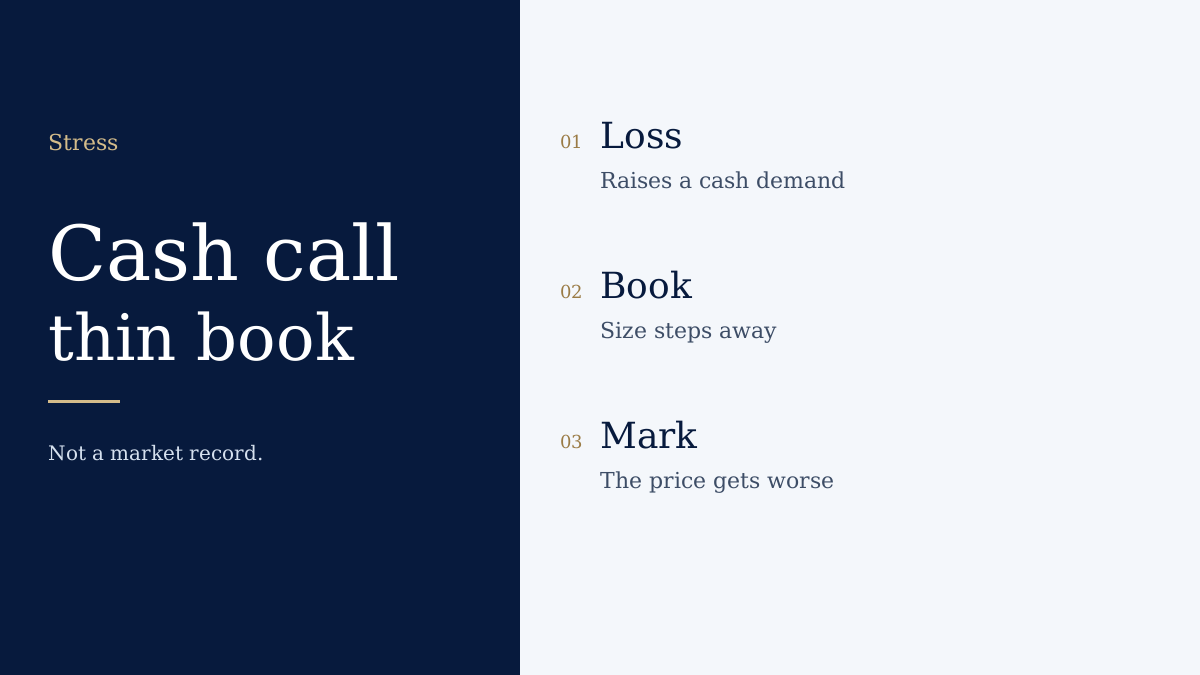
Market liquidity is the ability to trade. Funding liquidity is the ability to keep the cash the position requires. When both tighten, selling to raise cash meets a book that has already stepped back.
Key points
- A wider spread and a collateral call are different events that can coincide.
- Forced selling can push the price that the collateral rule is marking.
- This note does not assign a probability to that loop.
What is going on
BIS discussions of market stress describe funding and trading liquidity reinforcing each other. The mechanism is general: a loss raises a cash demand, the sale hits a thinner book, the worse price raises a further demand. It is not a claim that every decline works this way, and it is not a statistic for a named crisis copied from memory. High average volume does not promise that the book will be there on the day.
Why it matters
A trader can be solvent on a long-run view and still be unable to hold the position through the hour when the cash is due. An investor in a fund can meet the same mechanism if the fund sells into the same thin market to meet redemptions.
What to watch
Ask what would force a sale: a collateral rule, a redemption, a risk limit. Ask what the book looked like last time that kind of sale was crowded. Treat the answer as a scenario to size, not as a prediction.
Risks
Describing the loop is not a forecast of the next one. Illiquid holdings are not automatically the most volatile. The two failures are different.
Related
Sources and review
Written by: WiT Markets Editorial. Writes and structures WiT Markets pages. Separates a sourced fact from a cell that is Not confirmed.
Review: Editorially reviewed. This is not a qualified specialist review and it is not a legal sign-off.
Last reviewed: . Next review due . The date is an editorial pass. It is not a live check of every third-party fee.
Other sources
- Bank for International Settlements — checked 13 October 2026
- WiT Markets methodology — checked 13 October 2026
Methodology. Editorial policy. Corrections. Report an error.