Brokerage research and trading technology
Broker & Platform Intelligence
Understand the providers, costs, technology and protections behind a trade.
Independent research into the firm on the contract, the charges beside a headline commission, the technology that sends an order, and the rules that decide whether an account can be opened. Investigate what an account actually provides before treating a brochure as a fact.
Featured research
Execution and costs
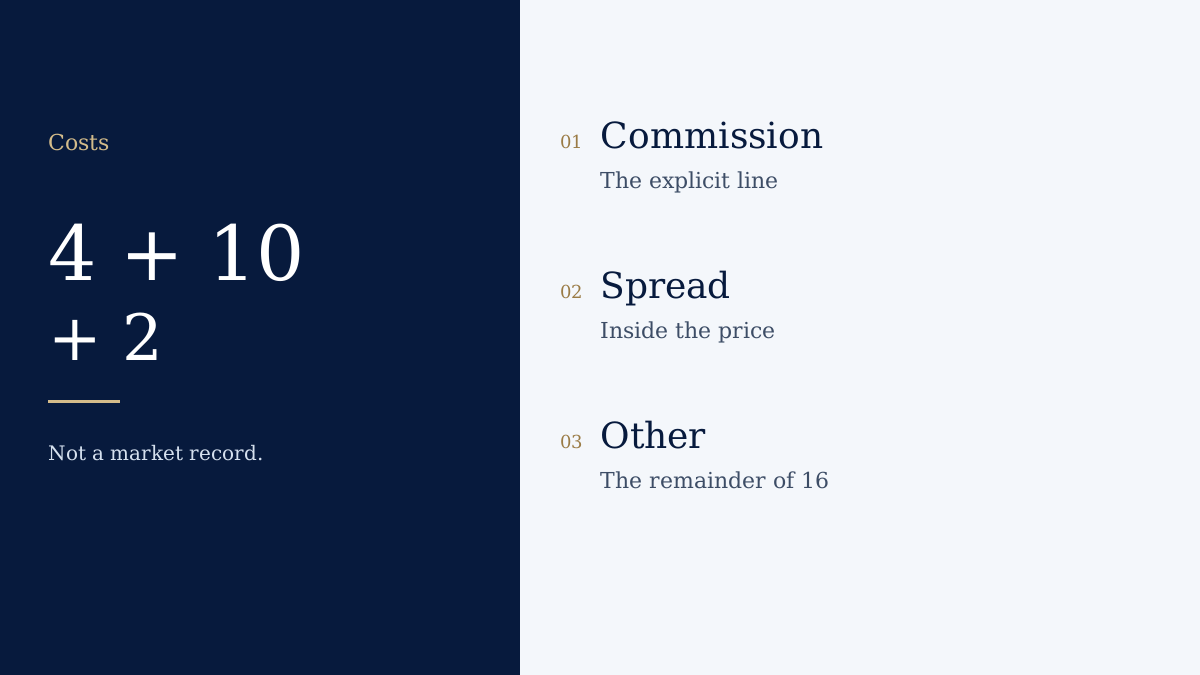
What a Headline Commission Leaves Out of the Bill
Understand the cost of trading beyond advertised brokerage commission. Spreads, FX conversion, execution charges, platform fees and user-entered comparisons.
Read analysis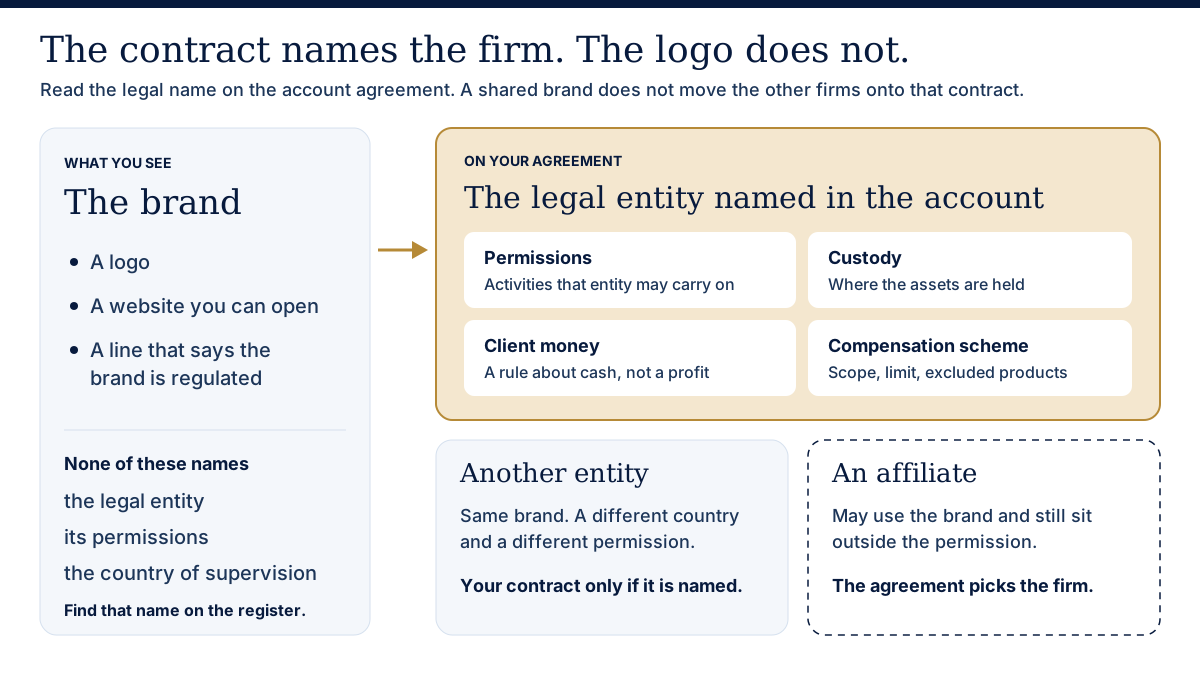
The legal entity on the contract is the firm you have
Why a brand’s regulatory status in one country does not travel with the website, and what custody and compensation schemes actually cover.
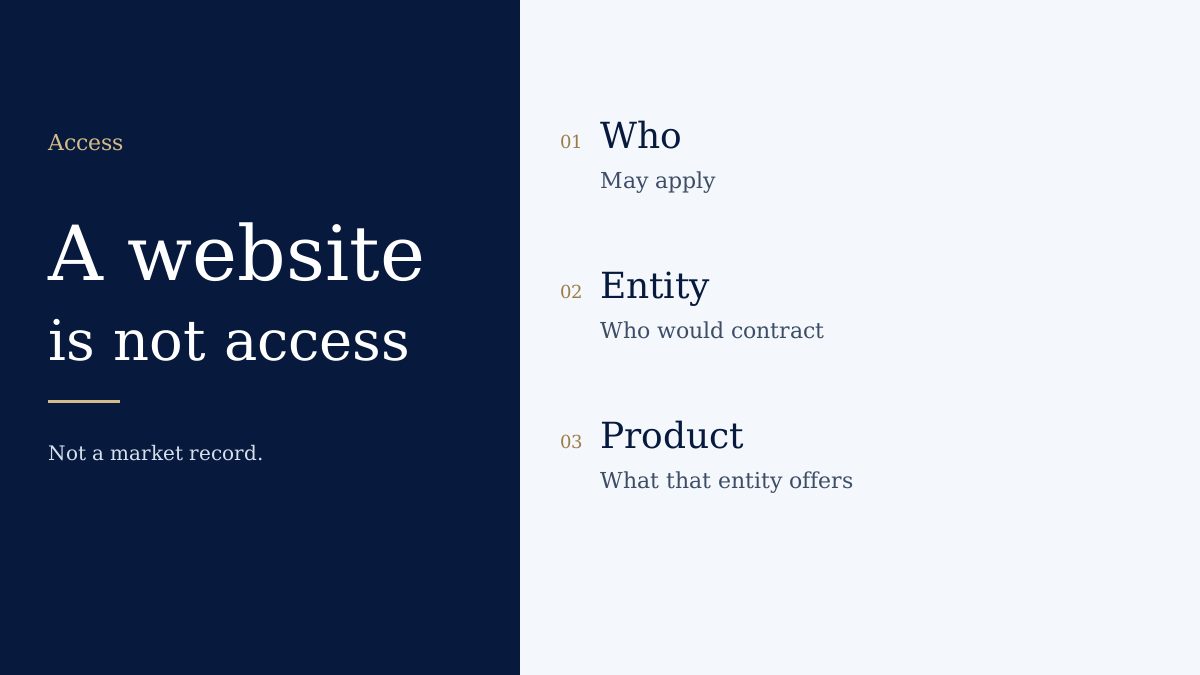
A website you can open is not an account you may hold
How country eligibility, product permissions and entity choice come apart, including for evaluation firms and event contracts.
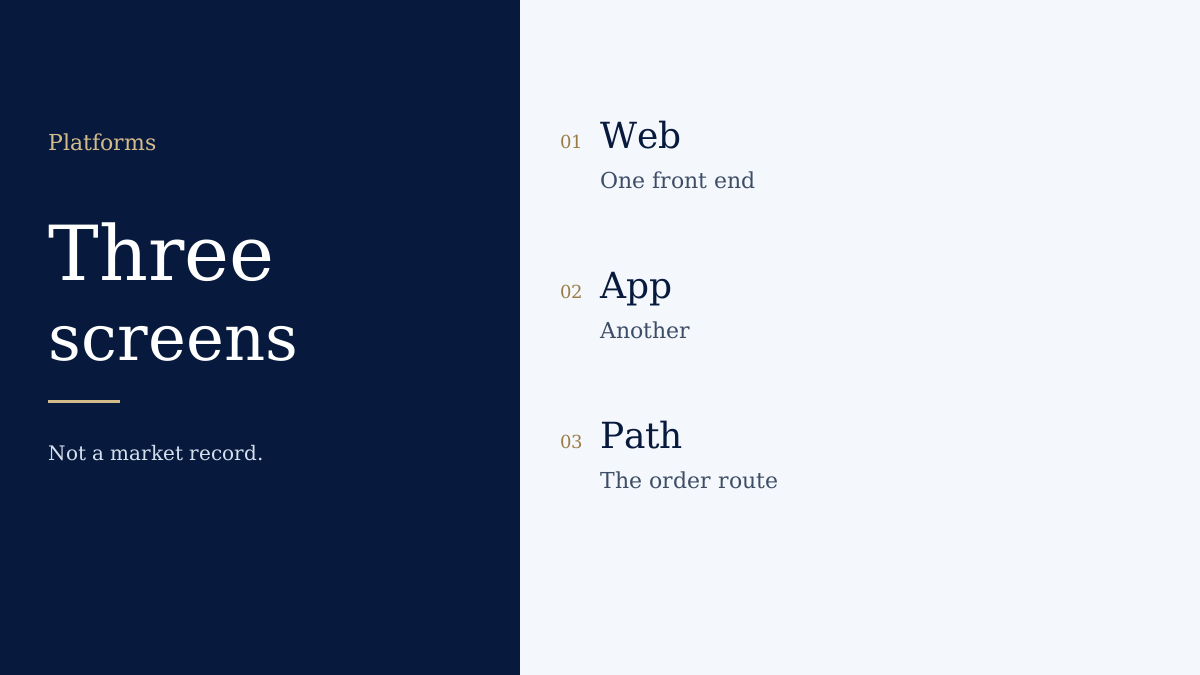
Desktop, web and mobile screens are not the same frontend
How a trading screen, a broker’s systems, a data vendor and a venue sit in different layers, and why one layer being fast does not describe the others.
Research categories
Eight questions. Counts are published notes carrying that tag. A category with a directory link is not a ranking of the firms on that directory.
Trading costs and execution
Commission, spread, venue charges, conversion, financing and the difference between a screen price and a fill.
Is the advertised commission the whole bill?
6 published notes
View researchLegal entities and custody
The contracting firm, its permissions, who holds assets, and the limit of any compensation scheme.
Which legal name is on the contract?
3 published notes
View researchEligibility and restrictions
Residence, account type and the products that entity may offer that person.
Does a page that loads mean you may open the account?
1 published note
View researchPlatforms and technology
Desktop, web, mobile, order types, exports and what a dropped session does to a working order.
Does the screen you will use have the order type?
4 published notes
View researchMarket access
Listed contracts, bilateral contracts and funds that can share a name and still be different positions.
Which venue or counterparty is actually offered?
1 published note
View researchOperational risk
Outages, collateral changes, restrictions and complaints. Authorisation is not uptime.
How do you reach the firm when the screen fails?
2 published notes
View researchEvaluation programmes
Fees, targets, drawdown and payout rules. A simulated balance is not capital you deposited.
Which figures did you read, and which balance is simulated?
0 published notes
View researchEvent contracts
Resolution source, fees and geographic blocks. A contract price is not a guaranteed forecast.
What happens if the resolution source is ambiguous?
0 published notes
View researchEvaluate a provider before funding an account
- 1Legal entity
- 2Permissions
- 3Eligibility
- 4Costs
- 5Technology
- 6Operational risk
Mark what you have read. Evidence recorded means you wrote down a source. Needs review means the document was incomplete. Neither mark is a finding by WiT Markets, and neither mark makes a firm safe or authorised.
1Legal entity
The agreement names the firm you can claim against. A brand can contain more than one firm.
- What legal name is on the account agreement?
- Is that the firm that would hold cash and positions?
Where to look: The regulator’s register, opened for that legal name.
Legal entity note2Permissions and eligibility
A website that loads is not permission to open the account or to trade every product on it.
- Which permission does the register show?
- Does that entity accept residents of the place you live?
- Which products are outside the permission?
Where to look: The register entry and the firm’s own eligibility notice.
Eligibility note3Market access
An asset-class label can hide a different venue, a different contract, or a bilateral counterparty.
- Which venue or counterparty is named?
- Which contracts are actually enabled for this account?
Where to look: The product list and, for a listed contract, the venue’s specification.
Market access note4Trading costs
Commission, spread, venue charges, conversion and financing are separate lines. A missing line is not zero.
- Is there a commission, a minimum, or both?
- Are venue charges included or passed through?
- How is currency conversion priced?
- Is there a charge for holding the position?
- Is market data included?
Where to look: The entity’s fee schedule and the venue’s own schedule where one applies.
Trading costs note5Platform technology
The screen you will use may not have the order types shown in a group brochure.
- Which order types does this frontend accept?
- What is exported after a fill?
- What happens if the session drops?
Where to look: The platform guide for the entity, not a generic product tour.
Platform note6Operational risk
Authorisation does not describe uptime, a collateral increase, or how a complaint is handled.
- How do you reach the firm if the screen fails?
- What happens to a working order during an interruption?
- Where is the complaints policy?
Where to look: The firm’s continuity and complaints documents.
Operational risk note
The economics of a trade
A headline commission is one explicit charge. A spread is an implicit cost of crossing the quote. Venue, clearing, conversion, financing and data can sit on other lines. A cost already inside a fill should not be added again as a separate spread.
The figure is the hypothetical round trip already used in the commission note: 4 of commission, 10 of spread, 2 of other charges, 16 in total. It is arithmetic. It is not a firm’s schedule and not a live market.
What sits between you and a fill
These layers fail in different places. A fast screen does not describe the venue, and a venue membership is not the same thing as a phone application.
- 1You
- 2Frontend
- 3Broker systems
- 4Venue or counterparty
- 5Clearing or custody
Execution
Market, limit and stop instructions are different rules. A stop can become a market order. A gap can pass the price you typed.
Analysis
Charts, depth and chains depend on a data entitlement. A delayed price is a different object from the venue’s live book.
Automation
An interface can send only what the account is allowed to trade. A dropped session is an operational event, described in the firm’s own specification.
Records
Fills, statements and exports are how you check the bill later. A journal on this site stores what you type. It does not import a broker file by itself.
Market access is a contract, not a label
Two firms can both say they offer a market and still differ in venue, contract, order types and whether the firm is the counterparty. Gold on a listed contract and gold as a bilateral position are the example already used on the commodity pages. The same split applies to a share versus a contract written on that share.
Where an account can be opened
Website access, a marketing permission and eligibility are three tests. A parent group’s permission in one country does not move to every subsidiary. Where this site has not verified a country, the status is not verified.
- 1Customer
- 2Contracting entity
- 3Execution
- 4Clearing or custody
Risks that are not the price move
Market
The price goes against the position, including through a gap.
Firm credit
The counterparty does not pay. Different from a listed contract that is cleared.
Operations
The screen, the gateway or the process fails. An order may still be working.
Rules
Collateral, a halt, or a permission can change what you are allowed to hold.
Evaluation programmes
Compare fees, targets and drawdown only with figures you have read. A simulated account size is not cash you deposited, and a fee does not create a right to a payout. The calculators do not import a hidden tariff.
Event contracts
Read the contract’s resolution source, the fee, and who may trade it. A quoted price can be described as an implied probability. It is not a guarantee that the event will resolve that way, and a thin book can make the quote a poor guide to a real order.
What do you need to investigate?
Questions
- Which lines are explicit, and which sit inside the price?
- Is a small order caught by a minimum charge?
What a headline commission leaves out
This points at research and a directory. It does not score a provider.
Provider directories
Each card opens an existing directory. Inclusion is not an endorsement. Order on those pages, where they publish a list, is not a score. A commercial relationship does not decide the wording here. Some destinations stay out of the staged public navigation because fees or permissions are not confirmed for launch. They are still the project’s directories, not a second list.
Stockbrokers
Listed shares and the provider notes on the stock-market page.
Open directoryIndex access
Benchmarks and the products that track them.
Open directoryCommodity providers
The commodities workbook, filtered by group on each category page.
Open directoryCurrency dealing
Currency markets and the provider notes filed there.
Open directoryListed derivatives brokers
Listed contracts, expiry and collateral.
Open directoryListed options access
Calls, puts and the provider notes filed there.
Open directoryDigital asset platforms
Custody and market structure for cryptoassets.
Open directoryEvaluation firms
Programme rules. A simulated size is not your cash.
Open directoryEvent-contract venues
Resolution and eligibility. A price is not a forecast.
Open directoryTrading software
Charting, screeners and other tools in the software directory.
Open directoryPublished notes
Search matches the title and the summary. Filters use the tags on published notes. Nothing unpublished is added to fill a gap.
Broker & Platform IntelligenceOperational risk
A firm can require more collateral than the venue’s minimum
How venue collateral, a broker’s own requirement and a liquidation rule differ, without quoting a current rate.
- Venue minimums and house requirements are different numbers.
- A change in collateral can force a reduction even when the thesis is unchanged.
- This note does not publish a current collateral rate.
Broker & Platform IntelligenceExecution and costs
A holding charge depends on how long the position stays open
Why bilateral products can add a financing charge for positions kept open, and why that charge is separate from the spread.
- A same-day round trip and a position held overnight can have different bills.
- The rate, the day-count and the direction of the position are terms to read.
- This note does not publish a financing rate.
Broker & Platform IntelligenceMarket access
A listed venue and a bilateral book are different access
Why two providers that both say they offer a market can still differ in venue, counterparty, contracts and permissions.
- A listed contract is an exchange instrument. A bilateral contract is with the firm.
- Two firms can both say a market is available and still list different venues and contracts.
- A marketing category is not an inventory of permissions.
Broker & Platform IntelligenceExecution and costs
A spread-only price and a per-trade charge are different bills
How currency-dealing accounts describe cost as a quote width, as a commission, or as both, without quoting a live spread.
- Spread-only and commission-plus-spread are different presentations of cost.
- A raw or tighter quote with a commission is not automatically cheaper.
- Holding the position can add a financing charge that the spread does not include.
Broker & Platform IntelligenceExecution and costs
A zero headline charge is not the same as a low all-in cost
Why removing a commission line does not remove the spread, conversion, financing or venue charges from a trade.
- Explicit commission and implicit spread are different lines.
- A cost already inside an execution price should not be added again on top.
- WiT Markets does not publish a live broker tariff on this note.
Broker & Platform IntelligencePlatform technology
Automated routing still fails when the path fails
What an application interface can and cannot promise about orders, security and a session that drops.
- An interface does not create a product the account is not allowed to trade.
- A dropped session can leave an order working, or can fail to send it. The specification says which.
- Keys and permissions are operational controls, not a strategy.
Calculators
Each tool starts from numbers you type. None of them looks up a broker’s tariff.
Profit and loss
A result from prices you type.
OpenInvestment fee
An annual charge against a return you assume.
OpenPosition size
Quantity from a risk, a stop and a multiplier you enter.
OpenStop and target
Distances you choose.
OpenProgramme comparison
Up to four programmes, on terms you enter.
OpenEvaluation cost
Fees you type. Not a hidden tariff.
OpenProgramme drawdown
A path from rules you enter.
OpenTrading journal
A record you keep.
OpenTrading performance
Figures from the journal.
OpenHow this section is written
Provider names, logos and fee lines stay in the market directories that already hold them. This hub does not copy those rows into a second list and does not turn a missing fee into zero. Regulatory status is a register entry you open, not a badge this page awards. The methodology, the commercial disclosure and the corrections page are the longer versions of those rules.
MethodologyEditorial policyCommercial disclosureCorrections
Sources and review
Written by: WiT Markets Editorial. Writes and structures WiT Markets pages. Separates a sourced fact from a cell that is Not confirmed.
Review: Editorially reviewed. This is not a qualified specialist review and it is not a legal sign-off.
Last reviewed: . Next review due . The date is an editorial pass. It is not a live check of every third-party fee.
Regulatory and official sources
- Investor.gov — checked 13 October 2026
- Financial Conduct Authority — checked 13 October 2026
- U.S. Securities and Exchange Commission — checked 13 October 2026
Other sources
- WiT Markets methodology — checked 13 October 2026
Methodology. Editorial policy. Corrections. Report an error.